 Skip to content







In custom packaging, precision is everything. A box that’s even slightly oversized wastes material and increases shipping costs. A box that’s too tight risks damaging the product and ruining customer experience. Yet many businesses struggle with one basic issue — how to properly measure box dimensions.
Understanding box dimension formulas and measurement standards is essential for brands, e-commerce sellers, and manufacturers who want cost-effective, secure, and professional packaging. Whether you’re designing rigid boxes, corrugated shipping cartons, retail packaging, or custom printed boxes, getting dimensions right is the foundation of successful packaging.
In this guide, we’ll break down the correct box measurement formula, explain industry standards, and help you avoid common mistakes that cost businesses money.
Why Accurate Box Dimensions Matter in Custom Packaging
Custom packaging is not just about appearance — it directly impacts logistics, branding, and profitability.
Correct box dimensions help you:
- Reduce shipping costs
- Prevent product damage
- Minimize material waste
- Improve storage efficiency
- Maintain professional brand presentation
In industries like e-commerce packaging, retail packaging, subscription boxes, and wholesale custom boxes, even small dimensional errors can significantly increase fulfillment expenses.
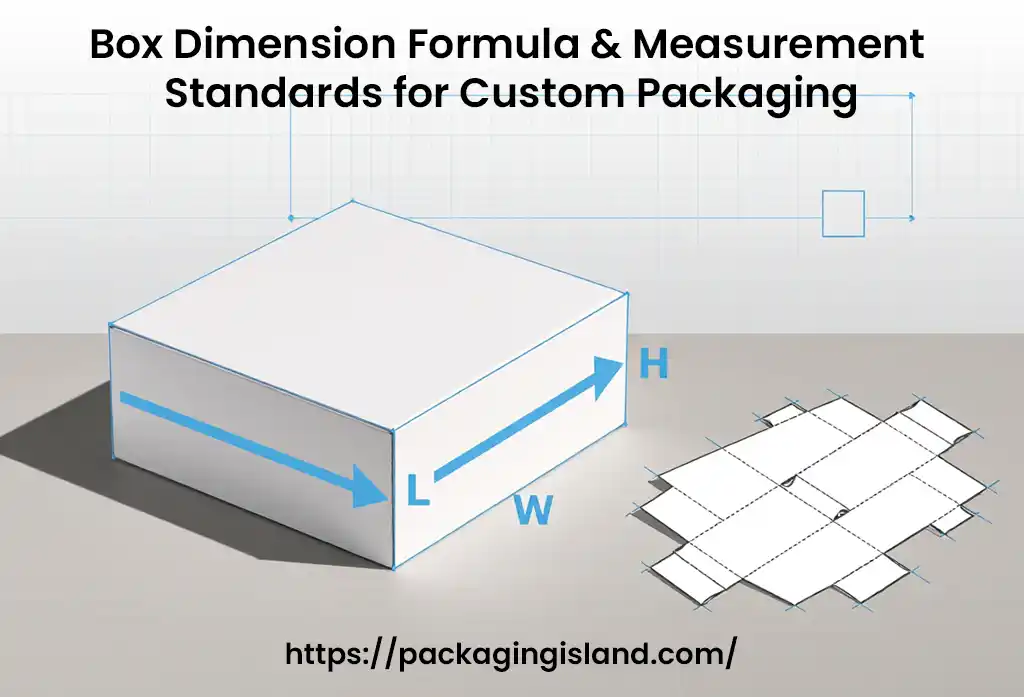
The Standard Box Dimension Formula (L × W × H)
The universal formula for measuring a box is:
Length × Width × Height (L × W × H)
This standard is used globally in custom packaging manufacturing.
Here’s how it works:
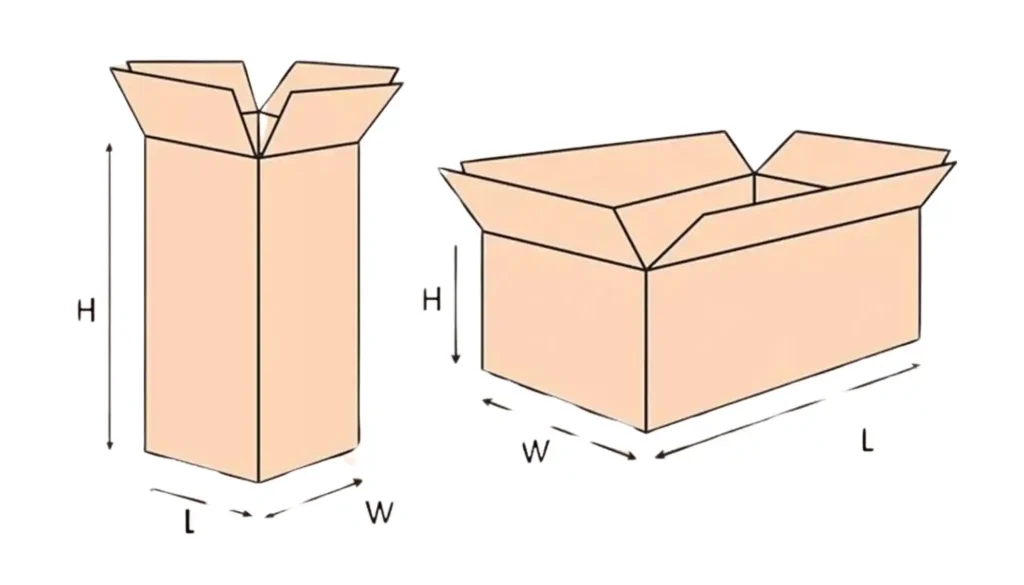
- Length (L): The longest side of the box (front to back)
- Width (W): The shorter side (left to right)
- Height (H): The vertical dimension (bottom to top)
For example:
If a box measures 12 inches long, 8 inches wide, and 4 inches high, it is written as:
12″ × 8″ × 4″
Important: The order matters. Always write dimensions in this sequence to avoid confusion with manufacturers.
Internal vs External Box Dimensions
One of the most misunderstood areas in packaging design is the difference between internal and external dimensions.
Internal Dimensions
These measure the usable space inside the box.
They are critical for ensuring the product fits properly.
External Dimensions
These include the thickness of the packaging material.
They are important for shipping calculations and pallet stacking.
For example, corrugated boxes may have thicker walls, meaning external dimensions can be significantly larger than internal measurements.
Common Box Styles & Measurement Standards
Different box types may require slightly different measuring approaches, but the L × W × H formula remains consistent.
1. Corrugated Shipping Boxes
Measured from the inside to ensure proper product fit.
2. Rigid Boxes
Often measured externally due to their thick structure.
3. Folding Cartons
Measured flat during manufacturing but calculated as assembled dimensions.
4. Mailer Boxes
Measured internally to accommodate protective inserts.
Understanding these standards ensures smooth communication with your packaging supplier and avoids production delays.
Box Measurement Comparison Chart
| Box Type | Measured From | Primary Use | Key Consideration |
|---|---|---|---|
| Corrugated Boxes | Internal | Shipping & E-commerce | Product protection |
| Rigid Boxes | External | Luxury packaging | Premium appearance |
| Folding Cartons | Internal (assembled) | Retail packaging | Print alignment |
| Mailer Boxes | Internal | Subscription boxes | Insert compatibility |
Calculating Box Volume (Cubic Measurement Formula)
Beyond basic dimensions, volume plays a crucial role in logistics and shipping costs.
The formula for box volume is:
Length × Width × Height = Cubic Volume
For example:
12 × 8 × 4 = 384 cubic inches
Shipping carriers often calculate pricing using dimensional weight (DIM weight), which factors in box volume rather than actual weight. Oversized packaging can drastically increase shipping fees, especially in the USA and international markets.
Measurement Units Used in Custom Packaging
Custom packaging manufacturers typically use:
- Inches (USA market)
- Millimeters (international manufacturing)
- Centimeters (retail packaging specs)
Consistency is critical. Switching between units without proper conversion leads to production errors.
Conversion example:
1 inch = 25.4 millimeters
Always confirm the measurement unit with your packaging supplier before finalizing artwork or dielines.
Common Mistakes to Avoid When Measuring Boxes
Even experienced sellers make costly errors.
1. Measuring the product loosely
Always measure at the widest points.
2. Ignoring protective inserts
Foam or cardboard inserts reduce internal space.
3. Forgetting material thickness
Thicker cardboard increases external size.
4. Incorrect dimension order
Mixing width and height creates manufacturing confusion.
Avoiding these mistakes ensures accurate custom box production and smooth logistics.
Why Proper Box Sizing Boosts Business Efficiency
Accurate packaging dimensions directly impact:
- Lower shipping costs
- Reduced warehouse space
- Improved customer satisfaction
- Better sustainability (less material waste)
- Enhanced unboxing experience
In competitive industries like custom packaging USA, wholesale custom boxes, and branded packaging solutions, efficiency equals profit
Frequently Asked Questions (FAQs)
1. What is the correct order for box dimensions?
The correct order is Length × Width × Height (L × W × H).
2. Should I measure inside or outside of a box?
Measure internal dimensions for product fit and external dimensions for shipping purposes.
3. How do I calculate box volume?
Multiply Length × Width × Height to get cubic volume.
4. Why do shipping costs increase with larger boxes?
Carriers use dimensional weight pricing based on volume, not just actual weight.
5. What unit is best for custom packaging measurements?
Inches are standard in the USA, while millimeters are common in international manufacturing.
Conclusion
Understanding the box dimension formula and measurement standards is not optional in custom packaging — it’s essential. From reducing shipping costs to preventing product damage and maintaining professional presentation, accurate measurements drive efficiency and profitability.
Whether you’re ordering custom printed boxes, rigid packaging, corrugated shipping cartons, or retail packaging solutions, mastering Length × Width × Height and volume calculations will give you a competitive advantage.
Precision in packaging isn’t just about math — it’s about protecting your product, your brand, and your bottom line.
Need expert consultation for accurate box sizing and custom packaging solutions? Get in touch with our packaging specialists today and ensure your packaging is engineered for performance and profitability.
Email us: inquiry@packagingisland.com
