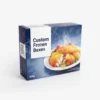
Custom Frozen Food Boxes
Frozen food packaging is a materials engineering problem that most brands discover too late — after they have already ordered packaging that looks great on screen and in physical samples, but fails in the freezer. Standard paperboard packaging without freeze-stable specifications warps as moisture is absorbed and released through freeze-thaw cycles. Standard printing inks crack or flake when board flexes at low temperatures. Laminations that seemed solid at room temperature begin to delaminate after weeks of frozen storage.
These are not design failures. They are specification failures — using materials that were not built for the frozen environment. And the consequence is packaging that communicates poor quality to the customer before they ever evaluate the product inside.
We build custom frozen food boxes for frozen meal brands, specialty frozen food companies, frozen snack producers, private label frozen product manufacturers, and any food brand where the packaging will spend extended time at temperatures below -18°C. Every specification decision — board grade, coating, ink type, lamination — is made with the frozen storage environment as the primary constraint.
What Freeze-Stable Specifications Actually Mean
Moisture-resistant board coating prevents the absorption that causes warping under freeze-thaw cycling. This is the most important single specification decision in frozen food packaging — standard uncoated board absorbs moisture when the product is taken from the freezer and condensation forms on the packaging surface. Repeated cycles of absorption and drying cause warping and structural degradation that eventually makes the packaging look damaged even when the product is perfectly preserved.
The moisture-resistant coating we specify for frozen applications is applied to both the exterior surface (preventing condensation absorption) and the interior where food contact occurs (preventing moisture transfer from the product to the board). The coating selection is based on the expected temperature range, the frequency of freeze-thaw cycling, and the fat content of the packaged product.
Flexible ink specifications prevent the cracking and flaking that standard inks develop when board flexes at frozen temperatures. The difference between standard and flexible ink specifications is invisible at room temperature — it only becomes apparent after weeks in a freezer, which is exactly when your customer is interacting with the packaging in a retail environment.
The Premiumization Trend in Frozen Food
The frozen food category in 2026 is in the middle of a quality revolution. Premium frozen meal brands — restaurant-quality frozen dinners developed by known chefs, specialty ethnic food frozen ranges, premium frozen meal kit solutions — are entering the market at price points that require packaging quality to match. A frozen meal at $14 or $18 cannot be packaged the same way as a $3 commodity frozen dinner. The packaging needs to communicate premium positioning consistently through freezer storage, retail display, and the customer’s home freezer.
Premium frozen food packaging uses the same design principles as premium ambient food packaging — restrained design, quality materials, specific ingredient communication. But the material specifications need to account for the frozen environment in ways that ambient food packaging does not. Getting both right simultaneously — premium visual communication and frozen-stable performance — is the specific challenge of premium frozen food packaging in 2026.
Private Label Frozen Food Packaging
Private label frozen food programs for grocery retailers, meal service brands, and specialty food companies need packaging that creates a distinct, professional brand identity while meeting the material specifications required for frozen food storage. Low minimum quantities for private label economics. Complete brand design from scratch. Consistent quality across production runs.
 Skip to content