 Skip to content




How Much Does Custom Packaging Really Cost?
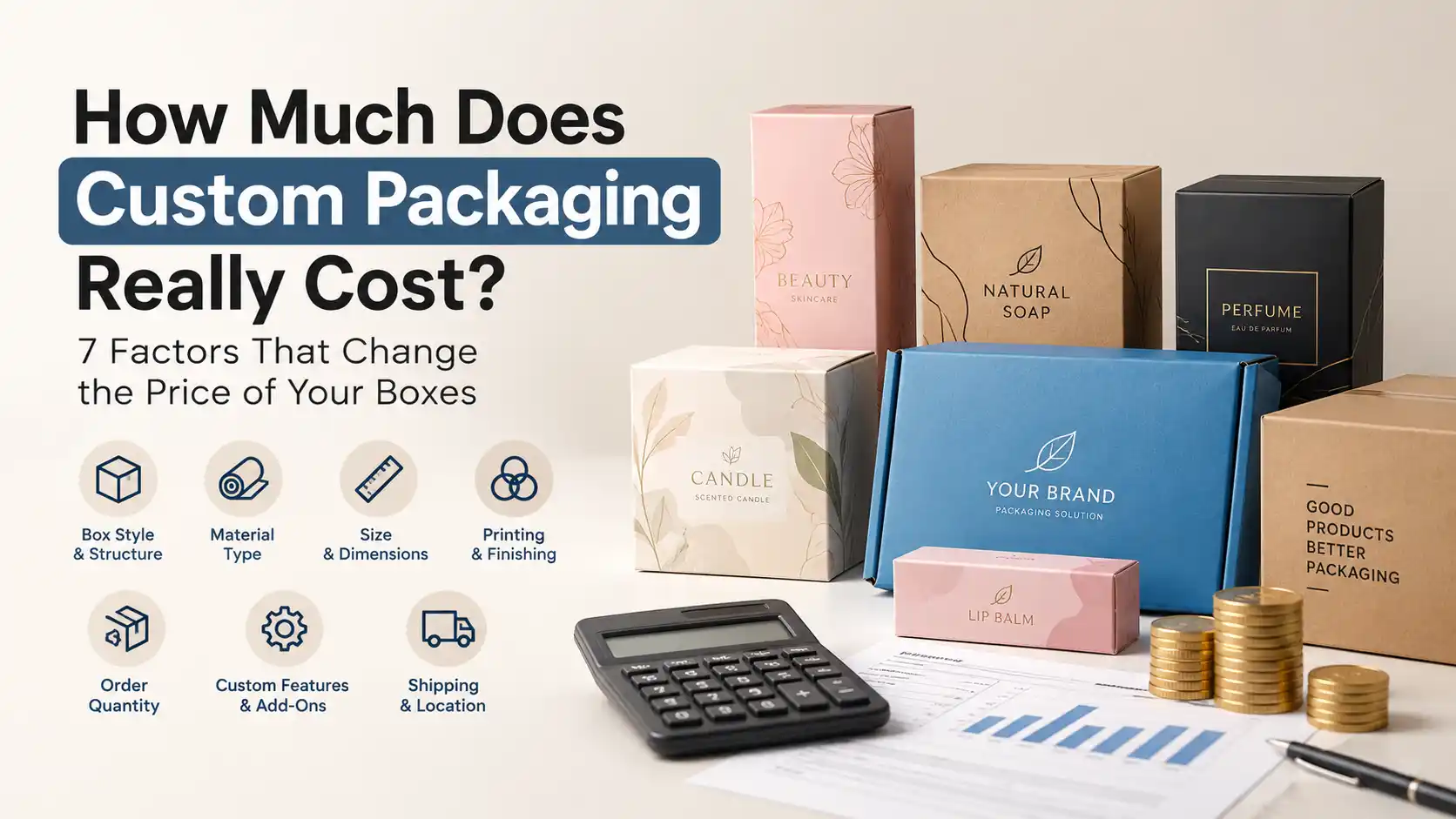
“How much for custom boxes?” is the most common question in this industry, and the honest answer is “it depends.” Two boxes that look similar on a screen can differ in price by a factor of several times once you account for what goes into making them.
The good news is that the price isn’t random. Seven factors drive almost every custom packaging quote. Once you understand them, you can predict your cost, spot where money is being spent, and make smart trade-offs before you order.
Key Takeaways
- Custom packaging cost is set by seven things: box style, size, material, quantity, printing, finishes and add-ons, and turnaround or shipping.
- Quantity has the biggest effect on per-unit price, because setup costs are spread across more boxes.
- Material and style set the baseline. Printing and finishes layer cost on top.
- A precise quote needs precise specs. Vague requests produce vague (and often inflated) prices.
- The cheapest quote isn’t always the lowest cost once reprints, damage, and returns are counted.
The Short Answer
There is no single price, but there is a pattern. Per-unit cost generally rises with structural complexity, bigger size, heavier material, more print coverage, and more finishes. It falls as order quantity rises.
For reference, here is how typical styles compare in relative terms (see your own pricing for exact figures):
| Box type | Relative cost | Typical use |
|---|---|---|
| Mailer box | Lower | E-commerce, apparel, subscription |
| Folding carton | Lower | Retail products, cosmetics, supplements |
| Corrugated shipping box | Lower to mid | Shipping and e-commerce |
| Sleeve and tray / two-piece | Mid | Gifting, retail presentation |
| Rigid setup box | Higher | Luxury, electronics, gift sets |
1. Box Style and Structure
The structure is the biggest baseline cost driver. A simple folding carton is die-cut, folded flat, and assembled by the customer. A rigid box is built by hand or semi-automatically, with wrapped paper over thick board, which takes more material and more labor.
What raises cost within style:
- Complex closures (magnetic lids, ribbon pulls, drawer systems)
- Windows or custom cut-outs
- Extra panels, dividers, or multi-part builds
- Hand assembly
Cost tip: If a standard structure can do the job, use it. A well-designed mailer box often looks as good as a more complex build for a fraction of the price.
2. Size and Dimensions
Bigger boxes use more material, which directly increases cost. They also take up more room in production, storage, and shipping.
Size has a second, less obvious effect on price. Every dimension affects how many boxes fit on a printer’s sheet. A small change in size can push a box onto a less efficient layout and waste board, raising cost without anyone noticing.
Cost tip: Size the box to the product, with no extra air. A snug fit costs less to make, less to ship, and looks more premium. Ask whether trimming a few millimeters would improve sheet efficiency.
3. Material and Board Type
Material sets both cost and feel. Common options include:
- Kraft paperboard: economical, natural look, good for eco-conscious brands
- SBS / coated paperboard: smooth surface, strong for detailed print
- Corrugated (E-flute, B-flute, etc.): protective for shipping, price varies with flute and strength
- Rigid greyboard: thick and premium, used in setup boxes
- Specialty and wrapped papers: textured or colored papers add cost
Thickness (caliper or GSM) matters too. Heavier board costs more but protects better and feels more valuable.
Cost tip: Match the board to the product. Over-specifying material wastes money, while under-specifying leads to damage and a cheap feel.
4. Order Quantity
Quantity moves price more than any other single factor. Custom packaging has fixed setup costs: tooling (the die), plates or digital setup, machine preparation, and proofing. Those costs are the same whether you order 100 boxes or 5,000.
At low volume, setup is spread across few boxes, so each one costs more. At high volume, the same setup cost shrinks per unit. This is why price per box drops noticeably as quantity climbs, with the biggest drops early and flatter gains later.
Cost tip:
- Ask for quotes at several quantity tiers (e.g.,50, 100, 250, 500, 1,000, 2,500) to see the curve
- Order enough to reach a good price break, but not so much that cash and storage get tied up
- If you’re testing a new product, start small and reorder once it sells
5. Printing and Artwork
Print is where cost climbs quickly or stays modest, depending on choices.
What affects print cost:
- Number of colors: one-color printing is cheaper than full-color CMYK; Pantone (spot) colors add cost
- Coverage: a logo on a plain box costs less than full-bleed artwork on every panel
- Inside printing: printing the interior adds another pass
- Print method: digital printing suits short runs; offset is more economical at higher volume
- Artwork readiness: files that need fixing take time and can delay or add cost
Cost tip: A one-color logo on kraft board can look sharp and intentional. If your brand allows it, minimal print is one of the easiest ways to cut cost without looking cheap. Send clean, print-ready files with correct bleed to avoid fix fees and reprints.
6. Finishes, Inserts, and Add-Ons
Finishes and extras are the “upgrade layer.” Each one adds cost but can raise perceived value.
Common add-ons:
- Matte, gloss, or soft-touch lamination
- Spot UV
- Foil stamping
- Embossing or debossing
- Custom inserts (cardboard, foam, molded pulp)
- Ribbons, magnets, handles, window film
Costs vary, but stacking several effects can add up fast.
Cost tip: Choose one or two finishes that serve the design. A matte box with a single spot UV logo often looks more premium than a box covered in effects, at a lower price. Spend where the customer touches and sees first.
7. Turnaround Time, Samples, and Shipping
These are the costs people forget to budget for.
- Turnaround: rush production usually costs more, and standard timelines are cheaper
- Samples and proofs: a physical sample or prototype may carry a fee, though it prevents far more expensive mistakes
- Shipping and freight: boxes are bulky, so weight, destination, and shipping method (air vs. sea) can be a large part of the total
- Duties and taxes: international orders may incur import costs
Cost tip: Plan ahead so you don’t pay for rush. Always ask for a landed cost (price delivered to your door) so the quote is comparable. A cheap per-unit price can hide expensive freight.
How to Get an Accurate Quote Fast
Vague requests get vague prices. Send these details and you’ll get a faster, more accurate quote:
- Box style (mailer, folding carton, rigid, etc.)
- Inside dimensions (L × W × H)
- Material and thickness, or ask for a recommendation
- Quantity (and the tiers you want compared)
- Print details: colors, coverage, inside print
- Finishes and inserts
- Delivery location and needed date
If you’re unsure about any of these, say so. A good supplier will guide you.
Where You Can Save Without Hurting Quality
- Simplify the structure if a standard style works
- Right-size the box to cut material and shipping
- Use fewer print colors or limit print coverage
- Pick one finish instead of stacking several
- Order at a price break that fits your cash flow
- Fix your files first to avoid reprints
- Plan lead time to skip rush fees
Where Cutting Corners Costs More
- Under-specified material: crushed products, returns, and bad reviews
- Skipping the proof: a wrong color across 2,000 boxes is expensive
- Choosing on unit price alone: freight, setup, and fees can erase the savings
- Wrong size: boxes that don’t fit become unusable inventory
Frequently Asked Questions
What is the minimum order for custom packaging?
It depends on the style and print method. Digital printing supports lower minimums, while offset and rigid boxes usually need higher quantities to be cost-effective. [ADD YOUR MOQs.]
Why is a small order so much more expensive per box?
Setup costs (tooling, plates, machine prep, proofing) are fixed. With fewer boxes, each one carries a bigger share. Price per unit drops as quantity rises.
Is a sample worth paying for?
Usually yes. A sample confirms size, fit, material feel, and color before you commit to a full run, and costs far less than a mistake on thousands of units.
Is custom printed packaging more expensive than plain boxes?
Yes, but the gap depends on print complexity. A simple one-color logo adds a small amount, while full-coverage, multi-finish designs add more. Many brands find branded packaging pays for itself through perceived value and repeat orders. [ADD VERIFIED STATISTIC + SOURCE, retrieved YYYY-MM-DD.]
How long does custom packaging take to produce?
Timelines depend on style, quantity, and complexity, plus shipping. Simple digital runs are fastest and rigid or heavily finished boxes take longer. [ADD YOUR STANDARD TURNAROUND.]
How can I lower my packaging cost without lowering quality?
Right-size the box, simplify print, pick one strong finish, and order at a sensible price break. Quality comes from fit, print clarity, and material choice, not from stacking expensive extras.
Conclusion
Custom packaging cost isn’t a mystery. It’s the sum of seven choices: style, size, material, quantity, print, finishes, and logistics. Understand how each one moves the price and you control the budget instead of the quote controlling you.
Send us your product dimensions, quantity, and the look you want, and we’ll give you a clear price with options to fit your budget.
Start your custom packaging order → quote page
